New understandings of history by Jessica Brunt
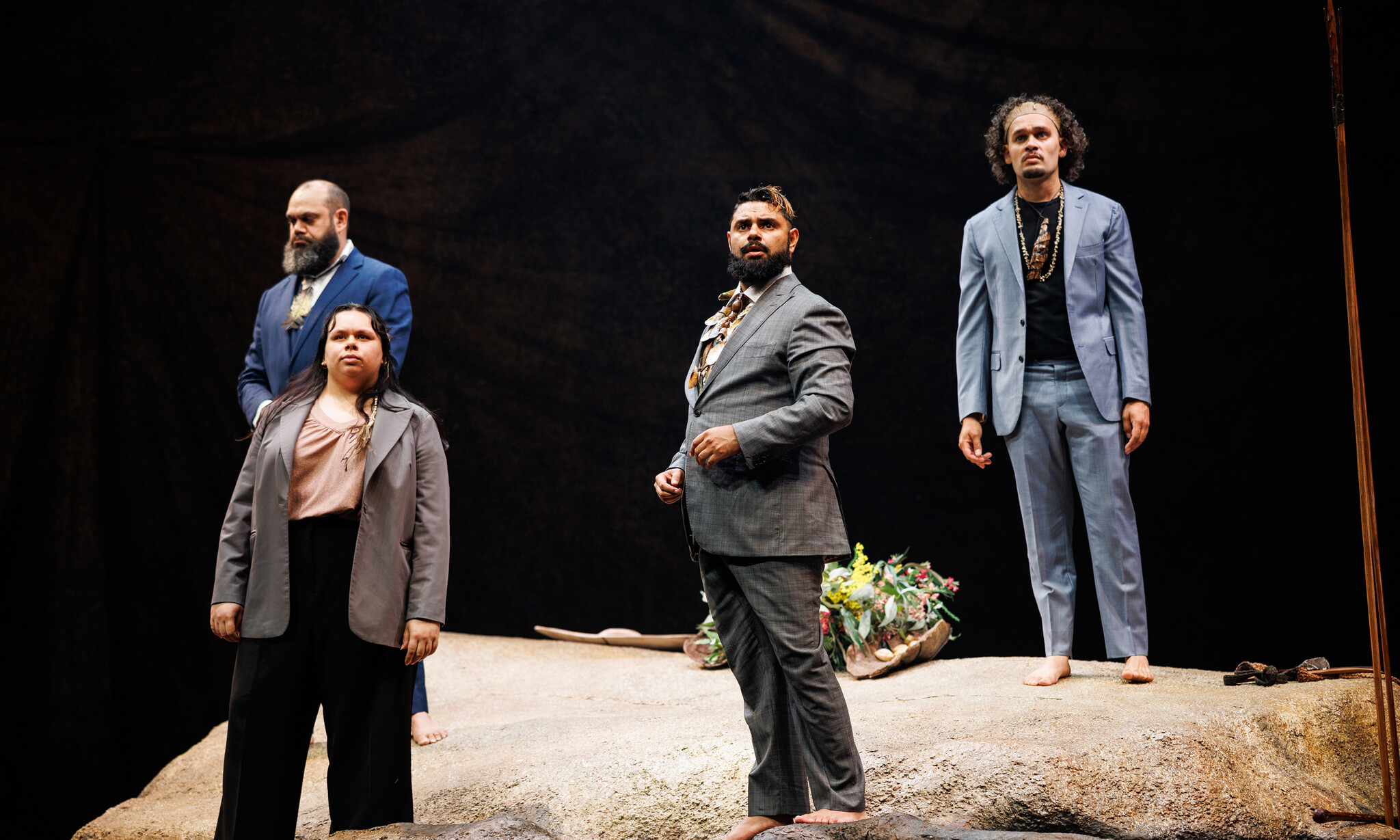
I had the perfect seats to watch The Visitors on Q Theatre's Rangatira stage. I was sitting in the second row to the bottom, which meant for much of the show I was looking up at the actors, with the set design making it so the actors repositioned themselves at various levels throughout the play. On beige rocks rising above the stage, decorated with warm lighting, a pile of pipi shells to the side, and a green bush sitting on top. The green bush highlighted the baroness of the rock and brought focus on the actors,making the stage feel isolated against the packed theatre. Although the actors had this striking set surrounding them, they spent most of the play looking out at a specific point in the distance. I had to fight not to turn my head to see what they were looking at.
What they were looking at was the first fleet of English ships arriving into Sydney Harbour in 1788. The Visitors asks how Indigenous Australians would have reacted when seeing these first English colonisers. The production explores this theme throughout the period of one day, focusing on the experience of watching these boats come to anchor.
In pursuing this idea, playwright Jane Harrison translates this period of history to a modern audience. Although most people know the history of the colonisation of Australia this play chooses a perspective that is often not told, particularly in popular media and history. The Visitors does this by blending cultural elements of First Nations people in Australia, such as the language, protocol and decorations, with recognizable elements like dressing in corporate wear and largely speaking in English. Parts of the play felt like glimpsing into the parliamentary discussions of 18th Century Australia.
The day I saw it, Sean Dow (Gunggandji, Birigubba), the actor who normally plays the character Gary, was unavailable so Associate Director Guy Simon (Birripi Worimi Waddi Waddi Walbunga) stepped in to play the role. In spite of this change Guy Simon embodied this role well. Initially watching him walk out holding a script I was concerned, but eventually I forgot he was even holding it. As the play went on the actors developed a rhythm between each other. Each character represented an area of Sydney that they led and the actors balanced both the discussion of their relationship to the land, and their individual personalities well. A great example that exhibited this successful balance was while referencing their past interactions with early European explorers as reasoning behind their opinions on the boats. The characters Albert (Beau Dean Riley Smith, Wiradjuri, Gamilaraay), Gordon (Stephen Geronimos, Gamilaroi) and Joseph (John Blair, Nucoorilma Gamilaroi) stand at the top of the rocks to retell stories from their encounters with the colonisers. These monologues were some of the most dynamic scenes in the show. The actors were able to highlight the individuality of their characters' lived experiences whilst bringing the audience in to relive the story with them. They did this through movement and tonal shifts and notably through sound. At one point Albert made loud bangs by bringing two wooden boomerang together to mimic the sound of gunshot. The way that characters used language in this play felt intentional and succinct. This was especially impressive considering the actors moved between English, and Dharag and Dharwal.
This show feels energetic despite the set remaining static throughout the 75 minutes. This places the audience in an interesting position. We are watching these characters from the vantage point of hundreds of years in the future, we are supposed to know what happened during this day, in this space, yet the story of these characters is new to us. At times I had to remind myself not to speak, as the actors drew me into this world I wanted to know more about.
Knowing the outcome of these historical events, I went into the play expecting to have an overbearing feeling of devastation. But this was subverted. What Harrison does well is flip the narrative of innate victimhood often placed on indigenous groups. By informing her writing through the oral history of First Nations people she points out the agency behind the decision to be made by this particular group; whether to turn away or to welcome the colonisers. Tears were still shed at the end, but I left with a new understanding of a story that I have been told over and over again.
About Jessica Brunt
Forever curious, post-grad student, Basement usher, and Stray Theatre Company executive member, Jessica Brunt is as much at home watching a live dance performance to Pink Floyd as she is Shakespeare. She is passionate about theatre being accessible and breaking barriers of location, cost, or language. (Two of her recent favourites were performances of Romeo and Juliet, first as a fast-paced 1960’s thriller with ATC and then as a traditional, but accessibly located and priced, Shakespeare In The Park offering.) Currently producing a show for Stray Theatre Company, Jess is heading towards a very bright future in theatre and community.